

Tracking pool certificate dates across your rent roll
What to record for each rental with a pool: certificate date, 1 or 2 year term, shared or not, Form 36 copies and smoke alarm dates, plus reminders.
For each rental with a pool, record whether the pool is shared or not, the date of the current pool safety certificate and its term (2 years for a non-shared pool and 1 year for a shared pool, as QBCC says), so the expiry date is on the list before a lease is signed. For a shared pool with no current certificate, record the Form 36 notice and who received it. A list of dates cannot say whether a pool meets the standard: a licensed pool safety inspector decides.Source: QBCC, Buy, sell or lease a property with a pool (page reviewed 15 May 2025, published 11 Jun 2026) and Inspect and certify a pool (30 Aug 2021), and the Residential Tenancies Authority's pool laws page (no review date shown), read 5 Nov 2026.
No card required. Prices include GST.
The rules the dates come from
- For a house with its own (non-shared) pool, QBCC says the lessor must not enter into an accommodation agreement unless a pool safety certificate is in effect.
- For a shared pool, the pool owner (usually the body corporate) must get the certificate. QBCC says that if there is no current certificate the lessor must lodge a Form 36 notice of no pool safety certificate, and the pool owner then has 90 days to obtain one. Forms can be lodged online, emailed, delivered or mailed.
- When you lease with a current certificate, QBCC says to give a copy to the new occupier and to the pool owner, usually the body corporate, and to display it as near as practicable to the entrance of the premises or the access to the pool.
- The RTA says a copy of the certificate should be included with the tenancy agreement, and that the entry condition report (Form 1a) has a tick box for the tenant to confirm they received it. For a shared pool with no certificate it says the property manager must notify the tenant or resident, the pool owner and QBCC using the QBCC notice.
- QBCC says if a property has a manager, the manager is responsible for keeping the pool in order and for making sure tenants and owners understand pool safety laws.
What to record for each pool
This list is our suggestion, built from the QBCC and RTA pages above.
- Property and pool. The address, and each pool if there is more than one.
- Shared or non-shared. It sets the term, and who must get the certificate.
- Certificate details. The certificate number, the date it was issued and the expiry date. The expiry is the issue date plus 2 years or 1 year.
- The inspector. Who issued it, and the inspector you usually use for this property.
- Form 36. If one was needed: the date, who got a copy (the tenant, the pool owner and QBCC) and the date the pool owner must get a certificate by. QBCC says a Form 36 is not an exemption from keeping the barrier to the standard. Keep the Form 36 and the proof of sending with the property papers: PoolPreCert does not lodge a Form 36 for you.
- Tenancy dates. The start and end of each lease, so you can see the expiry before a new one. Ask QBCC whether a renewal counts as entering into a new agreement.
- Who is responsible. The manager for the property.
- Smoke alarm dates. If you keep them for the same rentals. Smoke alarms are a separate matter from the pool certificate.
No card required. Prices include GST.
A spreadsheet or software
A spreadsheet works for a small portfolio if someone owns it: the columns above, an expiry formula and a filter on the next 60 days. What a spreadsheet does not do by itself is send the reminder, and a shared pool's shorter term is easy to miss in a long list. Software that stores the same fields and sends the reminder removes those two jobs.
What PoolPreCert does with these fields
- You can load properties and certificate dates from a CSV, and an updated file later updates your records without duplicates. See the import wizard.
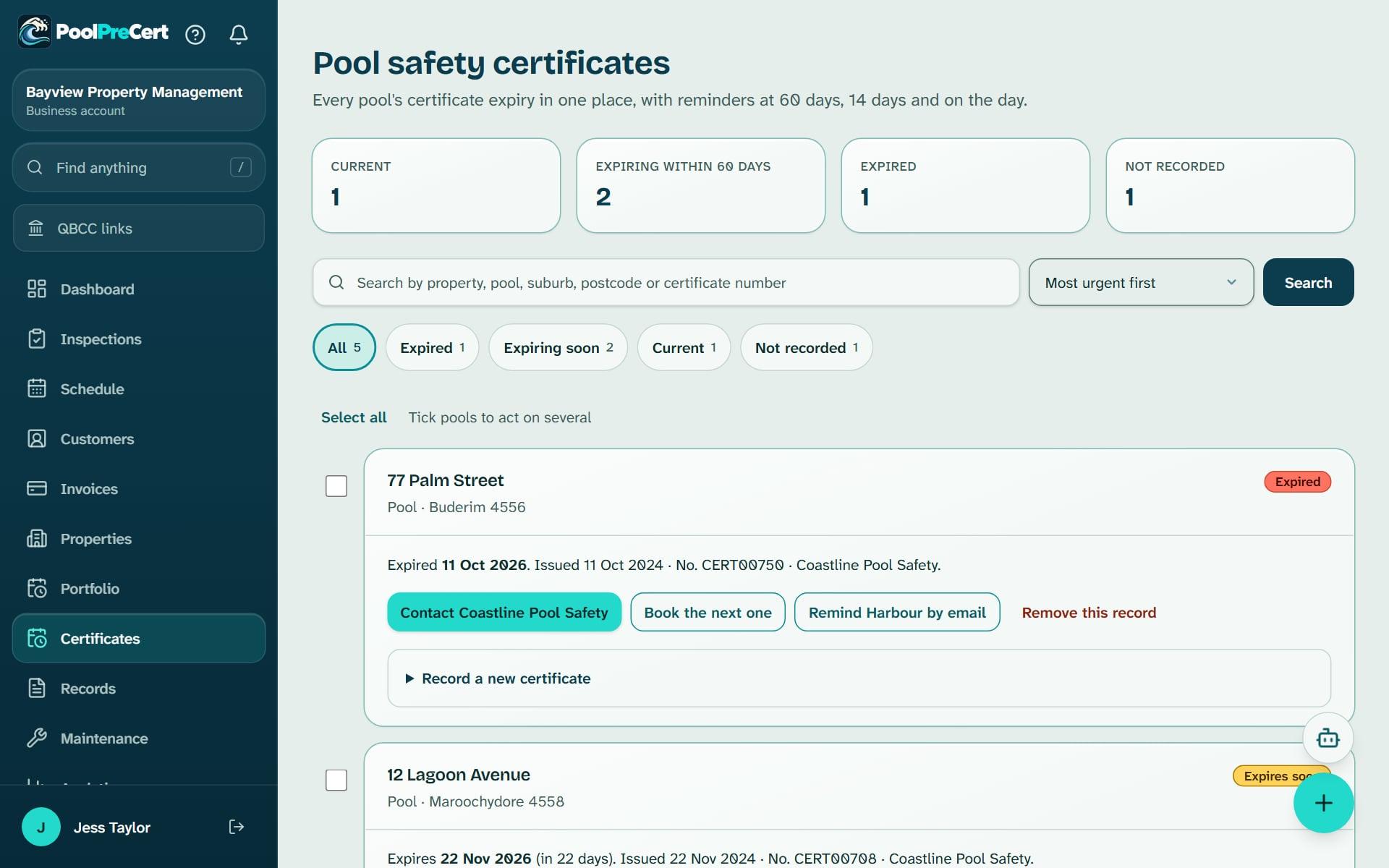
- The Portfolio list shows each pool's state as Current, Expiring within 60 days, Expired or No date recorded, with filters for manager, suburb and usual inspector, and CSV and PDF exports that contain no certificate numbers or personal details. See Portfolio.
- Reminders go by email at 60 days, 14 days and on the day, and for agencies can also go to each property's manager. See Certificates and reminders.
- On a pool that is expiring or expired you can ask your usual inspector for an inspection from the property. A request is not a booking and not an inspection.
- On an account set up as a real estate agency or property manager you can also keep a smoke alarm date for each rental and get an email reminder to your team 30 days before each tenancy, or on a date you choose. PoolPreCert does not check or test smoke alarms and does not say whether an alarm meets any rule. See smoke alarm dates.
- The dates are what you or your import recorded. PoolPreCert does not check them with QBCC live.
Prices are on the pricing page, with the trial length. All prices include GST.
How this page was made: the PoolPreCert team read each page listed under Sources on 5 November 2026 and wrote this in plain words. The dates beside each source are the dates those pages show. PoolPreCert is not part of QBCC or the Queensland Government, and only a licensed pool safety inspector decides whether a pool meets the standard.
Put the dates in one place
Start a trial with a few properties, or try the demo first. The demo is a private copy with example data.
The demo is a private copy with made-up example data. No sign-up.
Common questions
How long does a pool safety certificate last for a rental?
QBCC says 2 years for a non-shared pool and 1 year for a shared pool. A shared pool therefore comes round twice as often, so record the term against each pool.
Can a house with its own pool be leased with no certificate?
QBCC says that for a non-shared pool the lessor must not enter into an accommodation agreement unless a pool safety certificate is in effect. For a shared pool with no current certificate the lessor must lodge a Form 36 notice of no pool safety certificate, and the pool owner has 90 days to obtain one.
Who gets a copy of a certificate or a Form 36?
QBCC says that when you lease with a current certificate you give a copy to the new occupier and to the pool owner, usually the body corporate, and display it as near as practicable to the entrance or the pool access. The RTA says a property manager with no certificate for a shared pool must notify the tenant, the pool owner and QBCC, using the QBCC notice.
Does PoolPreCert check certificates with QBCC?
No. The dates are what you or your import recorded. The Certificates screen can also show what QBCC's published open data says, with an as-at date, and that can be out of date.
How do the reminders work?
Certificate reminders go by email at 60 days, 14 days and on the day. On an account set up as a real estate agency or property manager you can also keep a smoke alarm date for each rental and get an email reminder to your team 30 days before each tenancy, or on a date you choose. PoolPreCert does not check or test smoke alarms.
What does it cost?
See the pricing page. Starter is $49 a month and Business is $99 a month (incl. GST), both with a 14-day trial and no card required.