

New pool handover: the pool safety paperwork for the new owner
What QBCC says happens at a new pool's handover: the certifier's Form 17 or Form 11, registration, the builder's handover training and sale-time duties.
In Queensland the building certifier, not the pool builder, inspects and certifies the pool fence of a new pool before it is filled to 300 mm, issues a Form 17 or Form 11 and gives QBCC a copy. The builder's part at handover, as QBCC describes it, is to teach everyone who will care for the pool how to sanitise the water and run the filtration and chlorination equipment. The owner then registers the pool and, when the property is sold or leased, needs a pool safety certificate or the Form 17 or Form 11 route. A licensed pool safety inspector decides about any later inspection.Source: QBCC, Build a pool (page reviewed 30 Aug 2021, published 27 Jun 2022), Register a pool (25 Sep 2021, published 16 Jul 2024) and Inspect and certify a pool (30 Aug 2021), read 5 Nov 2026.
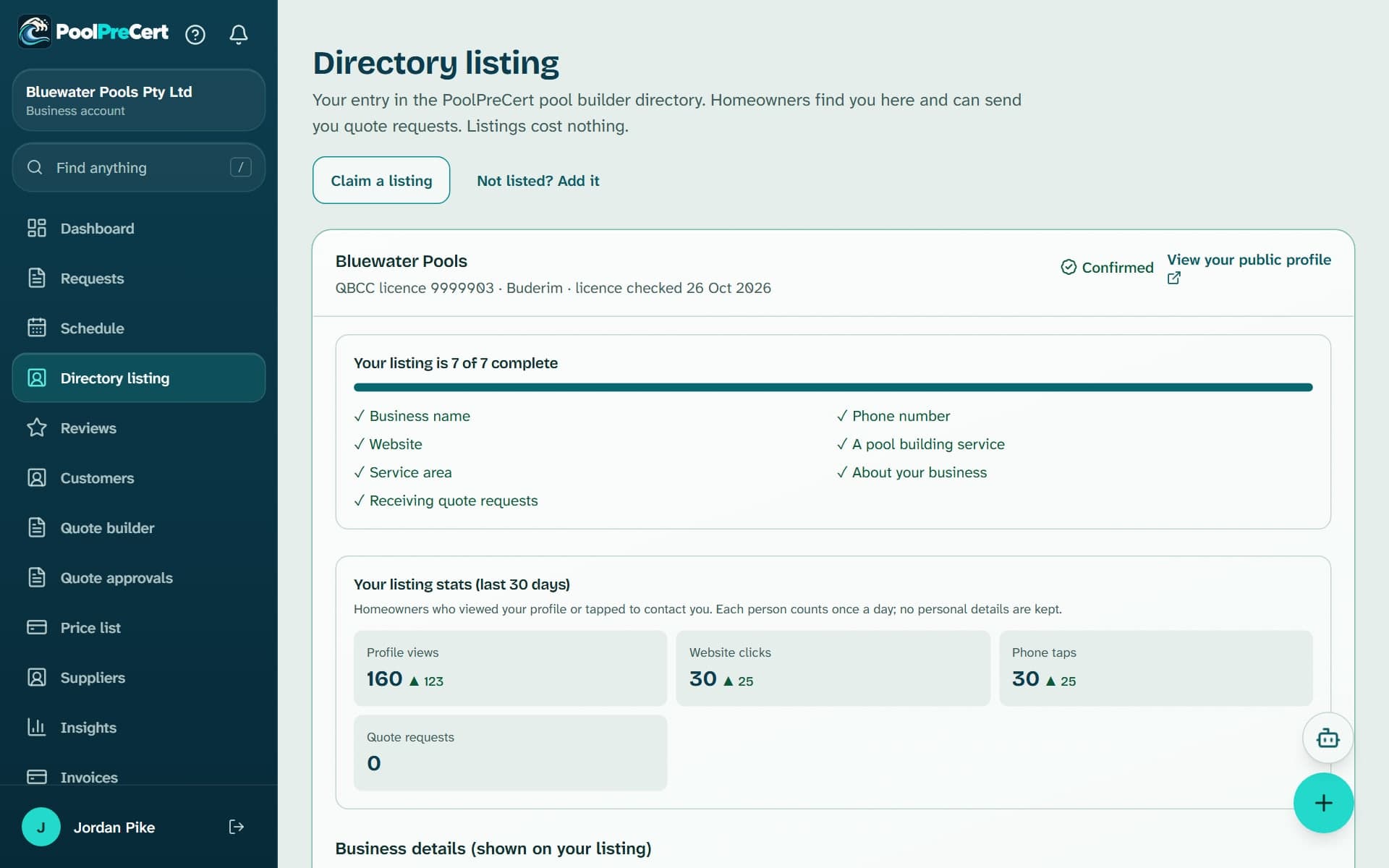
There is no charge to claim a listing.
Who does what at the end of a new pool
- The building certifier who approved the pool must inspect and certify the fence before the pool is filled to 300 mm or more. If approved, the certifier issues a Form 17 final inspection certificate for pools and barriers, or a Form 11 certificate of occupancy for a building with a regulated pool, and gives QBCC a copy.
- The builder gives the handover. QBCC says the builder must teach everyone who will care for the pool how to sanitise the water, operate and maintain the filtration equipment, and operate and maintain the chlorination equipment if there is one. The page lists no other documents.
- The owner makes sure the pool is registered, and keeps the fence and gate in order once the pool has water in it.
The temporary fence limit
QBCC says a pool under construction need not meet the pool safety standard until it is about to be filled to 300 mm or more, and that a temporary fence can be relied on for up to 3 months if the building certifier who approved the pool has inspected and approved it. The certifier should issue a Form 16. Longer than 3 months needs the certifier's further written approval, and a permanent fence must be in place before the certifier can give the final inspection certificate.
Form 17 or Form 11, and registration
- QBCC says that for a recently built pool, the owner can use a Form 17 or a Form 11 in place of a pool safety certificate, if it confirms the pool meets the standard and the certifier lodged it with QBCC. The page does not say how long this lasts.
- QBCC says the certifier who issues the final certificate must provide details to QBCC, which enters them in the pool register. The owner can also search the register, and register the pool address, on the QBCC Portal.
- QBCC says it audits properties and an unregistered pool can lead to a fine.
Warranty and the warning sign
- QBCC says the home warranty insurance premium is collected from the owner by the contractor, included in the contract, paid before work begins, and compulsory for residential construction work valued at more than $3,300. Cover lasts 6 years and 6 months from the earliest of the contract, the premium or the start of work, with a possible 6-month extension for long jobs.
- QBCC says a warning sign must go up before construction starts: it must say a swimming pool is under construction and that there is a danger to young children, sit within 1.5 m of the road frontage and be visible from the road.
A suggested handover pack
This is our suggestion, not a QBCC list. For the new owner, in one place:
- a copy of the Form 17 or Form 11, and the certifier's name and contact details;
- the date and what was shown at the handover (water, filtration, chlorination);
- the home warranty details from the contract;
- a note that the pool is on the QBCC pool register, and how to search it;
- a note that a pool safety certificate, or the Form 17 or Form 11 route QBCC describes, is needed when the property is sold or leased (see selling a house with a pool), and that a licensed pool safety inspector decides about any later inspection.
Offering the self-check to new owners
A business that has claimed its listing and has requests switched on gets a personal link, a QR code and a printable poster, plus a button for its own website, that opens PoolPreCert's self-check. It is the homeowner's own check, not an inspection, and the person can choose to send the result to your business. It is included in the plan with no extra charge. See how the Website button works.
How this page was made: the PoolPreCert team read each page listed under Sources on 5 November 2026 and wrote this in plain words. The dates beside each source are the dates those pages show. PoolPreCert is not part of QBCC or the Queensland Government, and only a licensed pool safety inspector decides whether a pool meets the standard.
Find your listing
Find the listing built from QBCC's register for your licence, and check it. There is no charge to claim it.
The demo is a private copy with made-up example data. No sign-up.
Common questions
Who inspects the fence of a new pool?
QBCC says the building certifier who approved the pool must inspect and certify the pool fence before the pool is filled to a depth of 300 mm or more. The certifier issues a Form 17 final inspection certificate for pools and barriers, or a Form 11 certificate of occupancy for a building with a regulated pool, and gives QBCC a copy.
Does a Form 17 or Form 11 replace a pool safety certificate?
QBCC says that for a recently built pool the owner can use a Form 17 or Form 11 in place of a pool safety certificate, if it confirms the pool meets the standard and the certifier lodged it with QBCC. QBCC does not say on that page how long this lasts, so ask QBCC about your date.
Who registers a new pool?
QBCC says the building certifier who issues the final certificate must give details to QBCC, which enters them in the pool register. QBCC also says owners can register their pool address on the QBCC Portal, and that it audits properties and an unregistered pool can lead to a fine.
What does the builder's handover cover?
QBCC says the builder must give a comprehensive handover and teach everyone who will care for the pool how to sanitise the water and operate and maintain the filtration equipment and, if there is one, the chlorination equipment. The page lists no other documents.
Can a builder offer the self-check to new owners?
Yes. A claimed business can get a personal link, a QR code and a printable poster, plus a button for its own website, that opens PoolPreCert's self-check. It is the homeowner's own check, not an inspection, and the person can choose to send the result to your business.